As some area residents organize opposition ahead of a city meeting, the head of TexAmericas Center says a proposed 500-acre data center campus is designed to limit impacts on local utilities and the environment. Tone
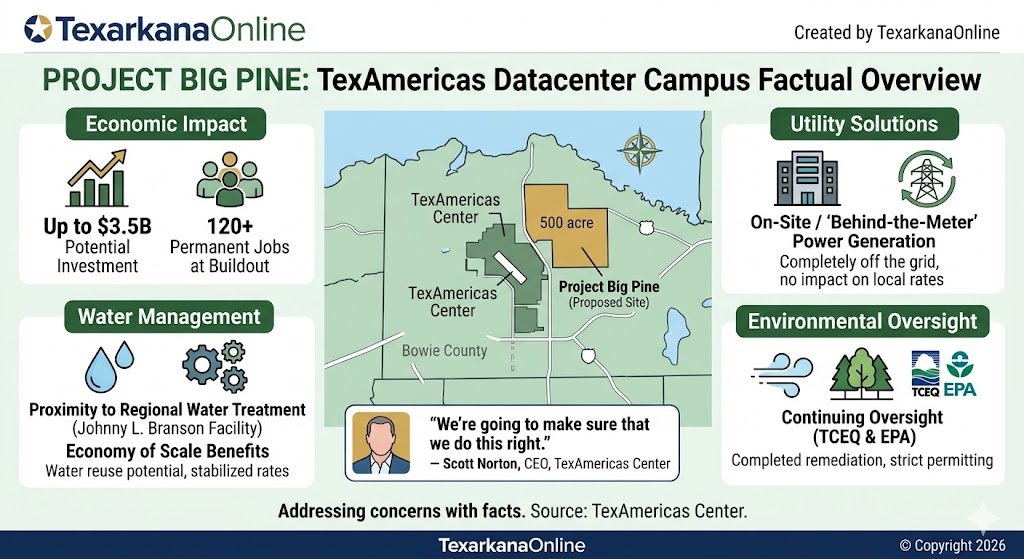
The site, known as Project Big Pine, is aimed at attracting data centers and other power-intensive users but would rely largely on on-site infrastructure, TexAmericas CEO Scott Norton said. The site could represent up to $3.5 billion in investment, and any future tenant will be contractually obligated to create at least 120 permanent jobs at full buildout, he said
No tenant has been finalized for the project, Norton said, though multiple companies have expressed interest.
A data center is a large industrial facility that houses thousands of computer servers used to process and store data, including workloads tied to artificial intelligence systems. These facilities operate continuously and require significant electricity for computing and cooling, as well as water in some designs.
Community concerns
Across the U.S., similar projects have drawn opposition from residents concerned about rising utility costs, heavy water consumption, noise and the potential strain on local infrastructure.
Since TexAmericas announced Project Big Pine on Monday, some residents in the Texarkana area have voiced concerns on social media, including Facebook, about potential effects on electricity costs, water use and environmental safety. Online discussions have included calls for petitions and for residents to attend the City Council meeting scheduled for May 11.
Jurisdiction & governance
The project is outside city control, Norton said, though the public can attend both city and TexAmericas Center board meetings to voice their concerns.
“This has nothing to do with the city of Texarkana,” he said, noting the city’s role is limited to appointing a member to the center’s board. Various other cities and Bowie County also appoint board members. Tone
TexAmericas Center operates as a state-recognized Local Redevelopment Authority, a largely autonomous public entity created to manage and redevelop former federal property. It controls land use and permitting within its footprint without needing local governments’ approval.
Power & water
The project is structured to avoid power issues by using “behind-the-meter” sources that generate electricity on-site rather than drawing it primarily from the regional grid.
“Their (tenants’) efforts are focused on independent power … completely off the grid and wholly contained on the property,” he said. “So it does not impact any of the customers other than them.”
There is currently no contract with area electricity provider Southwestern Electric Power Co., though future interconnection could be considered, he said.
On water use, Norton pointed to the site’s proximity to a regional water treatment plant being developed by the Riverbend Water Resources District. Most data center cooling systems involve “raw” untreated water that can be reused, he said, and additional industrial demand could actually help keep rates low.
“It’s simply an economy of scale,” Norton said. “It should help stabilize the water rates in the area.”
The treatment plant, called the Johnny L. Branson Regional Water Facility, will be on the TexAmericas campus, and according to previous Gazette reports, will eventually provide up to 30 million gallons of raw water a day.
Environmental & closing
The project site is part of the former Lone Star Army Ammunition Plant, which underwent years of environmental remediation before being cleared for industrial use. Oversight will continue through agencies including the Texas Commission on Environmental Quality and the Environmental Protection Agency, Norton said.
“There’s no lack of regulation,” he said. “We’re going to make sure that our tenants … have the proper permitting.”
Norton emphasized his personal connection to the area in addressing concerns.
“I live here. My parents live here. My family lives here,” he said. “We’re going to make sure that we do this right.”